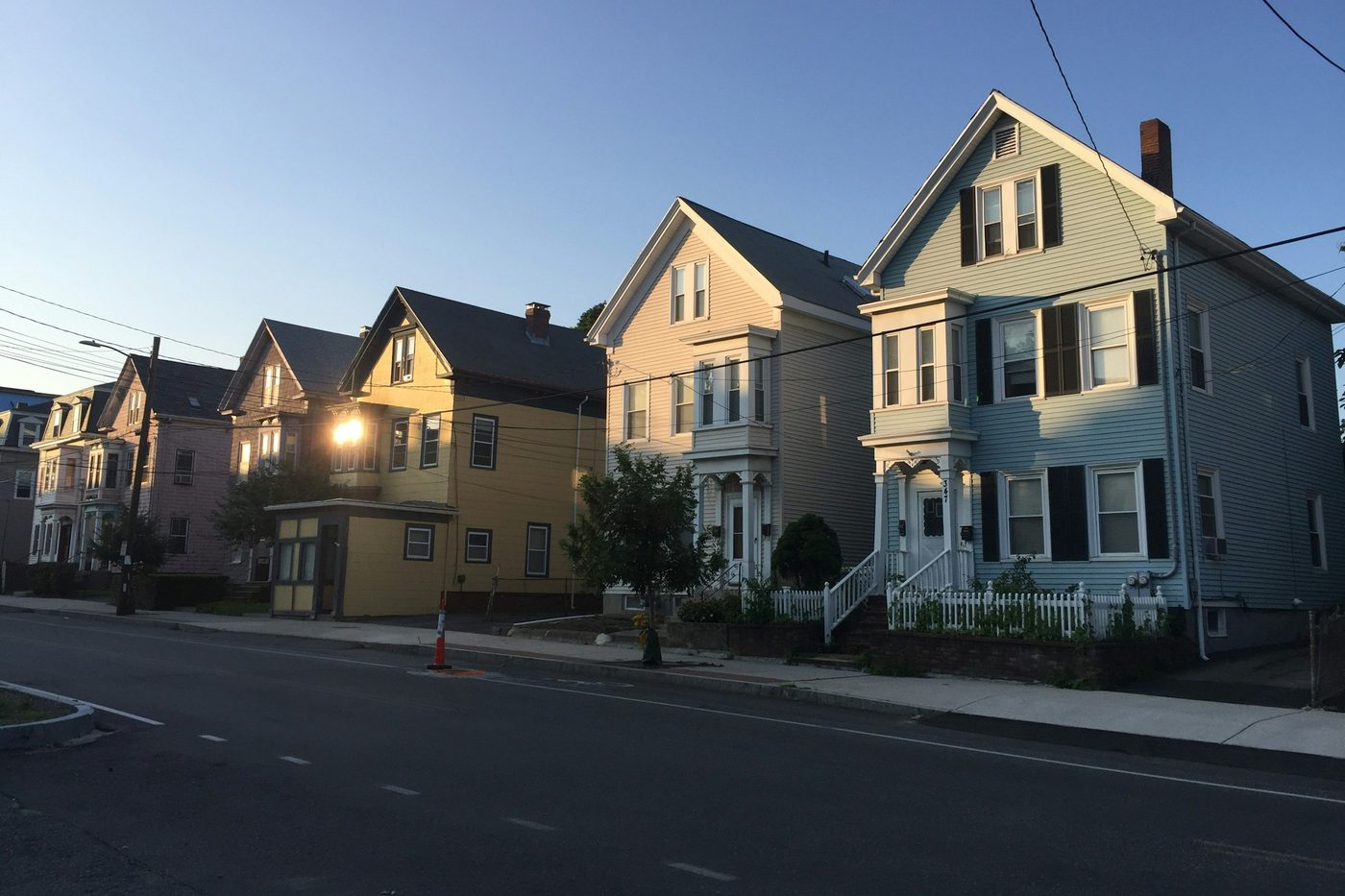
You are comparing two three-family houses. The asking prices are close. The rent rolls are close. One sits in a city with a high mill rate, and the other is a few miles away in a town with a low one. On a spreadsheet they look like the same deal.
To a rental lender they are not the same deal, and the reason is a line most investors copy off the listing sheet without a second look.
The short version
Taxes are the one part of a rental payment that neither you nor your lender sets. In Connecticut that line is set town by town, reset at revaluation, and raised when the assessor picks up a renovation. Check all three before you rely on a coverage ratio.
Where Taxes Sit In A DSCR Loan
DSCR is one division. Gross monthly rent goes on top. The full monthly payment goes underneath: principal, interest, taxes, insurance, and any association dues, usually shortened to PITIA. If the rent covers that payment with room to spare, the property carries itself. That is the whole basis on which a rental loan qualifies on the property's cash flow rather than on your personal income.
Rate and loan amount get most of the attention, because they set principal and interest. Taxes and insurance sit in the same denominator, dollar for dollar. An extra hundred dollars a month of property tax does exactly as much damage to the ratio as an extra hundred dollars of interest.
There is one difference. Principal and interest respond to what you do: borrow less and they fall. The tax line belongs to the town.
A bigger down payment shrinks the loan payment. It does nothing to the tax bill.
How A Connecticut Tax Bill Is Built
Property tax here is a municipal tax. There is no county bill, and each of the state's 169 towns and cities writes its own from two numbers.
- Assessed value. State law has municipalities assess real property at 70% of its fair market value. That value is fixed as of the town's last revaluation, not as of your purchase.
- Mill rate. Set by each municipality in its annual budget. One mill is one dollar of tax for every $1,000 of assessed value.
Multiply the assessed value by the mill rate and divide by 1,000, and you have the annual bill. Divide that by twelve and you have the figure that goes into the ratio.
Two wrinkles are worth knowing. Some properties also sit inside a special taxing district, such as a fire district or a borough, that adds its own mill rate on top of the town's. And Hartford is the one exception to the uniform 70% rule: state law lets the city assess smaller residential buildings at a lower ratio than apartment buildings and commercial property, so the class a building falls into changes its bill. The city assessor can tell you which applies.
We have left actual mill rates off this page on purpose. They change with every budget year, and they range far wider from town to town than most out-of-state investors expect. The Connecticut Office of Policy and Management publishes the current mill rate for every municipality and district, and the town assessor's office will confirm the one that applies to a specific address.
Same Rent, Two Towns
Take one building and move it across a town line. The price, the rent, the loan and the insurance all stay the same. Only the mill rate changes.
Illustrative arithmetic only. The mill rates are round numbers chosen to show the effect, not the rates of any Connecticut town, and the principal and interest figure is a placeholder rather than a quote.
|
Lower-rate town |
Higher-rate town |
| Assessed value |
$210,000 |
$210,000 |
| Mill rate |
20 mills |
36 mills |
| Tax per month |
$350 |
$630 |
| Principal and interest |
$1,450 |
$1,450 |
| Insurance |
$150 |
$150 |
| Full payment (PITIA) |
$1,950 |
$2,230 |
| Monthly rent |
$2,600 |
$2,600 |
| Coverage ratio |
1.33x |
1.17x |
Nothing about the borrower, the building or the tenants changed between those two columns. The town did, and the ratio moved from comfortable to thin.
That gap decides real things. Leverage and pricing on a DSCR loan generally step with the ratio, so a thinner number can mean a smaller loan or a higher cost on the same property. On a deal that was already close to break-even, it can decide whether the file fits at all.
None of this is an argument against higher-tax cities. Prices there often reflect the tax load, and plenty of strong rentals sit in them. It is an argument for giving every town its own tax line instead of a statewide rule of thumb. It is the reason, as our about page puts it, that a shoreline colonial and a Hartford three-family do not get the same set of assumptions.
Revaluation Years
The mill rate moves every year. The assessment moves less often, and when it does, it moves all at once.
Connecticut requires every municipality to revalue all real property at least once every five years. Between revaluations an assessment generally stays where it is. Buying the property does not, on its own, reset it. This is not a state where the tax bill re-prices to your purchase price at closing.
When a revaluation lands after several years of rising prices, assessments jump and the mill rate usually falls to compensate. The two rarely cancel out for any single property. The burden shifts toward whichever kind of property gained the most value since the last revaluation, so if small multi-family buildings outran the rest of the town, a rental's bill can rise even as the mill rate drops.
So the seller's current bill may be the last one written on an old valuation. Before you size a loan against it, find out when the town's next revaluation takes effect. The state publishes the revaluation schedule for every municipality, and the assessor can tell you whether new values are already in hand.
After A Renovation
This is where investors who renovate and keep get caught.
Assessors update their records for new construction and for work done under a building permit, measured as of October 1 each year. A house bought as a shell and finished as a fully renovated rental will not keep the shell's tax bill. The assessment follows the improvements, and the bill follows the assessment.
That matters most on the plan where a short-term bridge loan funds the purchase and the work, and a long-term rental loan replaces it once the property is leased. The refinance is underwritten on the finished property, so the tax line in the ratio should be the finished property's tax line, not the figure that came with the listing. The other half of that refinance, which value the new loan is written against, is a subject of its own.
You do not have to guess. Assessment records are public, and most towns publish them online. Look up what comparable renovated buildings on nearby streets are assessed at, and run your ratio on that.
The Insurance Line, Especially On The Shoreline
Insurance sits in the same denominator and behaves the same way. On the shoreline, where we are based, the part that surprises people is flood. A building in a mapped flood hazard area will generally need a flood policy on top of the hazard policy, and both premiums count toward the payment.
Get real quotes for the specific address before you make the offer, not a placeholder figure per unit. A ratio built on a guessed premium is only as good as the guess.
Running The Number Before You Offer
The coverage ratio on a Connecticut DSCR loan is only as good as its inputs, and every one of these can be checked in an afternoon.
- Pull the current assessment and the current mill rate. Use the assessor's record rather than the tax figure on the listing, which may be a year or more out of date.
- Add any district tax. A fire district, a borough, or similar.
- Ask when the next revaluation takes effect. If it is close, treat the current bill as a floor.
- If you are renovating, price the finished building. Use the assessments on comparable renovated properties in the same town.
- Get insurance quotes for the address. Include flood where the map calls for it.
- Use the rent a lender will use. We take the lower of the signed lease and the appraiser's market rent, so an above-market lease does not rescue a thin ratio.
If the number comes in thinner than you hoped, more equity will lower principal and interest, although it will not touch the tax bill. If you believe the assessment itself is wrong, Connecticut gives owners an appeal to the town's Board of Assessment Appeals, with a filing deadline that usually falls in February. Treat that as a remedy for an error, not as a plan. Underwrite to the bill as it stands.
Or send us the address, the rent and the current tax bill. We will run the ratio on the town's actual numbers and tell you what the file supports, usually the same day, and there is no credit pull to get a number.
This article describes how property tax and coverage ratios generally work; it is not a description of any particular loan program and is not an offer, a quote, or a commitment to lend. The figures in the example are illustrative only. Assessments, mill rates, district taxes and revaluation schedules are set by each municipality and change over time, so confirm them with the town assessor, and take tax questions to your own adviser. Nothing here is tax or legal advice. Riva Lending originates business-purpose loans secured by non-owner-occupied real estate; we are not a consumer lender and we do not originate loans on primary residences or second homes.